Friday, January 3, 2014

Urban food in Jordan


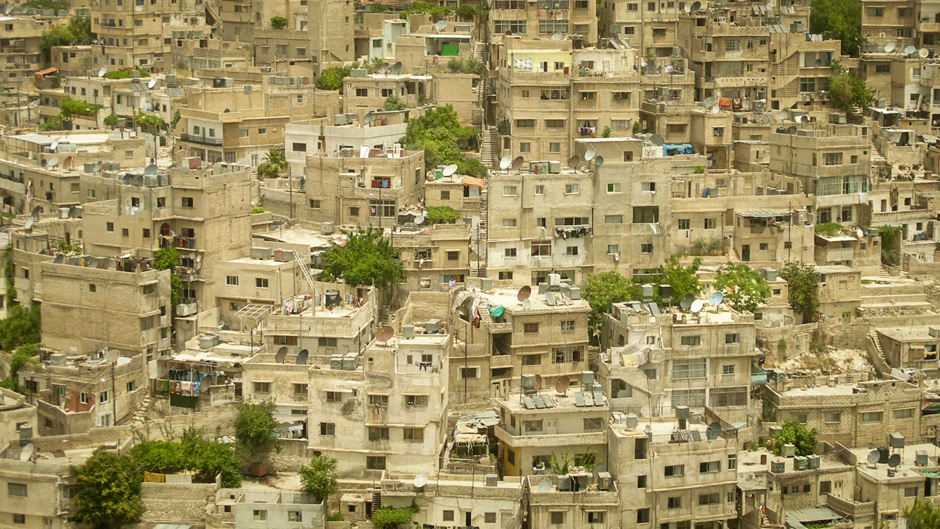
A slowly but steadily growing phenomenon in Jordan, urban agriculture has vast potential for reducing poverty and improving food security, and it has the added benefit of greening and cleaning up more rundown sections of cities.

But the success of urban agriculture depends on key components that are increasingly difficult to secure: land and water. Space for planting is growing ever slimmer in Jordan, and the country suffers from a perpetual shortage of water. While such problems are major, they have also forced those involved in urban agriculture in Amman to devise innovative and efficient ways to work around them.

The more successful they are, the more valuable urban agriculture becomes in Jordan, where two-thirds of the 160,000 people who are food insecure live in cities and 13 percent of the population lives below the poverty line. For them, urban agriculture is not a complete solution, but it does alleviate poverty, and in the long term, its indirect benefits can be even more widespread.

In Home Gardens, Income and Food for Urban Poor (OurWorld 2.0)

Thursday, December 26, 2013

Cars do not belong in cities


Cars do not belong in cities.  A standard American sedan can comfortably hold 4+ adults w/ luggage, can travel in excess of 100 miles per hour, and can travel 300+ miles at a time without stopping to refuel.  These are all great things if you are traveling long distances between cities.  If you are going by yourself to pickup your dry cleaning, then cars are insanely over-engineered for the task.  It’s like hammering in a nail with a diesel-powered pile driver.   To achieve all these feats (high capacity, high speed, and long range driving), cars must be large and powered by fossil fuels.  So when you get a few hundred (or thousand) cars squeezed onto narrow city streets, you are left with snarled traffic and stifling smog.

Even if you ignore the pollution, cars simply take up too much space.   Next time you are stuck in traffic behind what seems like a million cars, try to imagine if all those cars where replaced by pedestrians or bike riders.  Suddenly, the congestion is gone.

Cars Kill Cities (Progressive Transit)

Permaculture suburbs

Once upon a time, all the talk in hippy circles was of the end of suburbia. But what if we could create suburbs that are designed to function in harmony with their surroundings?

That's the concept behind Village Homes in Davis, California. From passive solar housing through neighborhood fruit orchards, chicken coops and beehives to a carefully designed system of swales which is intended to let rainwater percolate into the ground, this 70 acre, 225-home site is about as harmonious as one can image any suburb to be.


How to build a permaculture suburb (Treehugger)

Monday, October 21, 2013

Wastewater treatment


The Omega Center for Sustainable Living may be the most beautiful wastewater treatment plant in the world. Invented by Dr. John Todd, the building is powered by solar and geothermal power, so it requires no additional power to operate. Unlike other wastewater treatment plants, the OCSL does not use chemicals to treat the water, but rather mimics the processes of the nature world, such as using a combination of microorganisms, algae, plants and gravel and sand filtration to clean sewage water and return clean drinkable water back to the aquifer.

In addition to doing all of this, the OCSL also functions as a classroom, to help educate and inspire people about the power of nature to provide solutions.

The world's most beautiful wastewater treatment plant (Treehugger)

Saturday, October 19, 2013

Sharing cities


Imagine a city where everyone’s needs are met because people make the personal choice to share. Where everyone can create meaningful livelihoods. Where fresh, local food is available to all. Where affordable housing and shared transportation are abundant. Where the poor are lifted up, the middle class is strengthened, and the rich are respected because they all work together for the common good.
Imagine a city where the people decide how the city budget is spent. Where the people own the banks, control credit, and create their own money. Where the people own the utilities that make green energy and internet access available to all.

Imagine a city where all this is possible without relying on the government or big banks. Where we don't have to beg leaders for change or sell ourselves out to “make it” at the expense of others. Where the more we share, the more we have. Where everyone wins.

Our dream at Shareable is that everyone gets to live in such a place. While ambitious, our dream is grounded in reality. Everything that's imagined above already exists. We know this because we’ve written about these pockets of sanity nearly every day for the last five years.

Join the Sharing Cities Network (Shareable)

Ancient Roman bathhouses


We were standing next to the smaller bath, its circular rim beautifully shaped by large white blocks of stone worn smooth over centuries of use. Complete with a ledge on which to sit, it resembled a sort of ancient hot tub.

"The Romans built them, before Jesus," shouted one man, shampoo bottle in hand. Another piped up: "But they were damaged in an earthquake and that's when the Ottomans came and repaired it."

Indeed there had been an earthquake in the 14th Century. Even if their dates were a little out, you couldn't fault their enthusiasm and glowing pride.

In fact, as I stepped over the stretched legs and passed reclined bodies dangling their legs in the sea-green water, I got the impression nothing had really changed since the baths were constructed in the first century AD. Only the more recent Ottoman brickwork, the newly constructed changing room doors and the numerous brightly coloured plastic buckets gave the game away.

The important social function of a bathhouse has also been retained - family issues are discussed and resolved and jokes and stories are told to echoing laughter and the sound of a slapped thigh, back or hand.

Sport is heatedly debated, politics perhaps less so in this country - suspicion of who is hearing what remains a hangover from the civil war when careless talk cost lives. Few have the stomach or wish to risk more conflict - one of many plausible explanations as to why the Arab Spring went largely unnoticed in Algeria.

A Roman bathhouse still in use after 2,000 years (BBC News)

Thursday, September 26, 2013

The taberna in modern times


A taberna world is a personal world, not plastic, generic, bland, and abstract, like today’s world. Pattern 87 gives us a society where shopping doesn’t rob the individual and the community of dignity and choice and enables more localised transparency for the true costs of the transactions made. I’m sorry that today’s consumer culture, if not turned around, will just enlarge this hole of emptiness, just like sugar does for the hole in your tooth. The more you get, the worse the pain. Pattern 87 offers a new kind of shopping, where shopping sustains both community and personal relationships. And this is what we really need!

Surely, the ancient taberna belongs to a future world of joy, sustainability and freedom!
Pattern 87, INDIVIDUALLY OWNED SHOPS:

When shops are too large, or controlled by absentee owners, they become plastic, bland, and abstract.

    Therefore:

    Do what you can to encourage the development of individually owned shops. Approve applications for business licenses only if the business is owned by those people who actually work and manage the store. Approve new commercial building permits only if the proposed structure includes many very very small rental spaces.

    The profit motive creates a tendency for shops to become larger. But the larger they become, the less personal their service is, and the harder it is for other small shops to survive. Soon, the shops in the economy are almost entirely controlled by chain stores and franchises.

    The franchises are doubly vicious. They create the image of individual ownership; they give a man who doesn’t have enough capital to start his own store the chance to run a store that seems like his; and they spread like wildfire. But they create even more plastic, bland, and abstract services. The individual managers have almost no control over the goods they sell, the food they serve; policies are tightly controlled; the personal quality of individually owned shops is altogether broken down.

    Communities can only get this personal quality back if they prohibit all forms of franchise and chain stores, place limits on the actual size of stores in a community, and prohibit absentee owners from owning shops. In short, they must do what they can to keep the wealth generated by the local community in the hands of that community.

    Even then, it will not be possible to maintain this pattern unless the size of the shop spaces available for rent is small. One of the biggest reasons for the rise of large, nationally owned franchises is that the financial risk of starting a business are so enormous for the average individual. The failure of a single owner’s business can be catastrophic for him personally; and it happens, in large part because he can’t afford the rent. Many hundreds of tiny shops, with low rents, will keep the initial risk for a shop keeper who is starting, to a minimum.

    Shops of Morocco, India, Peru, and the older parts of older towns, are often no more than 50 square feet in area. Just room for a person and some merchandise – but plenty big enough. — Pattern 87, A Pattern Language by Christopher Alexander, page 432 – 434
The Ancient Taberna in a Future World (Øyvind Holmstad, Resilience.org)